The Contractor by Charles Holdefer
September, 2007 - 200 pages - $26.00

George Young has a demanding job, working on a secret island prison as freelance interrogator for the US government. He's good at what he does and doesn't mind the job until prisoner #4141 dies during an interrogation, haunting George enough to make him think twice about his job and what kind of person he wants to be. The job, though, isn't George's only problem. As part of a morale-boosting experiment George's family joins him on the island and it soon become clear there's crisis too where his family is concerned.
Holdefer has written about a hot button issue without relying on sensationalism.
The Contractor deals with aspects of torture, interrogation and contractors doing governmental work. But Holdefer doesn't stop there, displaying the deep pain and conflict of a man who must come to terms his role in the death of a prisoner and perhaps more importantly the effects of George's dilemma on a family already careening towards a crisis. The detailed nature of Holdefer's writing and attention paid to both aspects of George Young's life make this book a recommended read.
Kelly Hewitt: Some of the reviews of
The Contractor have billed the interrogation scenes in the book vivid enough to make the reader squeamish. It feels to me as though you’ve written very authentic scenes that are sometimes tough to read but in the end quite necessary to the book. How much thought did you put into the reader’s response when writing those parts of the book? Did you ever think about making them more or less dramatic?
Charles Holdefer: There’s surely less violence in
The Contractor than in a typical action movie that adolescents go and see. Maybe what some people are reacting to is the fact that the book doesn’t respect certain formulas. That’s on purpose. Not sucking up to people is actually a form of respect, treating them like adults. Action formulas are patronizing. Maybe some people have forgotten how to be frank.
Kelly:
The Contractor is a work based on an issue, with its secret island used for interrogation, that is currently very important to the American public. Is this your first experience writing about such a hot button issue?
Charles: Yes, it’s turned out to be that way. But that wasn’t planned. Writing a book is a long-term project. It took me a couple of years, while it’s only since last month that the major media decided that contractors were a big story. But it’s been there a long time now, a slow-motion train wreck. My publisher, Martin Shepard at the Permanent Press, believed in the book and started pushing it early and now there’s some momentum. But so many things are beyond one’s control.
Kelly: The protagonist in your book, George, works as an interrogator for the US government at a military camp on a secret island. As part of an experiment George is allowed to bring his family along with him – a family that is facing its own crisis. Do you think that government officials should be allowed to bring their families with them in situations like George’s?
Charles: The particulars of the family arrangement are a fictional liberty, but it was worth taking because I wanted to address a general truth, about the toll on families. The divorces, the grief, the trouble for children. These are real. These are a story you don’t hear enough about, for troops or contractors. And in the end I could tell the story better by thrusting the characters closely together. In earlier drafts of the book, George spends more time on the airplane, between work and home. That’s probably more realistic, strictly speaking. But airplanes are so boring, you know! I like a concentrated effect.
Kelly: You have worked on honing your writing skills in some very interesting places, spending time at the Iowa Writer’s Workshop and then at the University of Paris – two very different places. How was the transition from Iowa to Paris? How did the curriculum vary?
Charles: The transition to Paris was more about people than about schools. At the time I was in love with a French woman. So I followed her to France. At first I had no intention of ever going back to school. The reason I enrolled in the Sorbonne was because my job prospects as a foreigner were shaky and being a student was on way to get carte de séjour, a residence card. It’s a classic immigrant dodge. Having valid papers is a big deal in this world, anyone who’s experienced that pressure will tell you. Pretty soon I began to see other advantages, too, because universities in France are almost free, which was an eye-opener. One of the reasons I’d thought I was finished with school was because I was already in debt for student loans and didn’t want to go deeper in that hole. But here tuition wasn’t an issue. So I gave it a try and there were some bumps but eventually it worked out. The main difficulty was language. It was tough writing academic work in French. It’s one thing to speak a language, but producing good prose is something else altogether. It’s hard as hell. I had some long-suffering proofreaders. But I don’t regret the experience. Actually I think it was good for my fiction, because writing in a language that wasn’t my own was like trying to run a race with weights on my feet, and when I got back to telling stories in English, it felt so good. So light! I really started having fun again. That’s how I remember writing my novel
Apology For Big Rod. Like somebody opened a window and I just ran up and jumped out.
Kelly:
The Contractor has been getting some great pre-release buzz. The book has been selected as an ABA "Book Sense Pick" for November and there have been some really positive reviews. How does that make you feel? Did you feel like this book was really going to take off like this?
 Charles
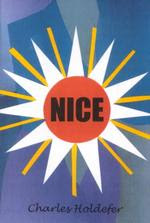
: I’m grateful for any good review, sure. And to the ABA . I’ve been an obscure writer and now I’m a slightly less obscure writer. But to be honest, I’ve always felt that any of my books might take off. Of course I’m prejudiced. Every writer has an ego! And you know some of the places giving me good reviews now didn’t give me bad reviews before. They simply didn’t review me at all. There wasn’t the same coverage. And some of the limited coverage was clueless—that’s not ego, that’s just a fact. The most hostile review I ever had was when Publishers Weekly panned my novel
Nice by dissing Iowa , when anyone who’s read the book will know that the story isn’t set there. Actually the word only appears once in the entire text, in reference to the character’s mother. I was a bit shocked at the time but it’s surely a common thing. A book appears, people act out their feelings, and the book disappears. So you sit down and write another.
Kelly: You have been doing some advanced press for the book, traveling to radio stations around the country. Is that something that you've done for previous books? How have
these radio interviews been going?
Charles: Since I live in Europe, radio is a good way to maintain a presence in the US . We do interviews over the phone. The internet makes it easier, too. What usually happens, though, is the host hasn’t read the book and the conversation is about politics. I have my opinions like anybody else, but why should anybody give a damn about what some writer guy thinks about, say, the attorney general? It’s a fine line, really. A novel is richer and more complicated than a soundbite. I’m grateful to be invited but I'm also pretty sick of post 9/11 careerism by politicians and by people in the entertainment industry. It's important to avoid that horseshit. One thing that strikes me in interviews is how controlled everything is, how much the language is policed. Lots of people will refer to “enhanced interrogation methods” when they talk about what used to be called torture. Even the word “abuse” is abused, made into something more familiar like substance abuse, in order to avoid the word torture. I’m sure it conditions how people think, or even if they think. I used to believe it was trivial if a movie on an airplane began with an announcement that it had been “edited” for in-flight viewing—instead of “censored”—it was to protect the kiddies, I’d supposed. Then I’d arrive at my destination and pick up my “previously-owned vehicle”, which was somehow supposedly better than a used car. It was so dumb and transparent I used to laugh at that stuff. But now I’m tired of it. I don’t like being treated like one of the kiddies.
In this morning’s New York Times , there’s a reference to an audit of contractors allegedly over-billing, and it says that many passages have been “redacted” by the government. Of course they mean censored, but a chronic gutlessness has infected their usage. I had an interview on Air America which was “live” but with a time delay of a few seconds, so it wasn’t, actually, "live". I guess they were afraid I’d have a wardrobe malfunction on the radio. It’s true, for instance, that the word “fuck” appears in
The Contractor , because sometimes people speak that way. But it would’ve been more acceptable (and not legally actionable) to read aloud a torture scene than to have that word uttered on air. As if, with that word, all of a sudden dams would break and planes fall out of the sky and in the sandbox little Johnny would hit his playmate over the head with a sand-shovel. In a novel, at least, I can say what I want.
Kelly: In a few days the book will be released. What goes through the mind of an author who is preparing for the release of a book with as much promise as yours?
Charles: That’s a friendly question. The book is already out before the official release date in many places. My main feeling is that, well, the situation is out of my hands now. Whatever happens happens. I’m working pretty hard on the next book, actually. That’s what occupies my mind.
Kelly: With the great response you've been getting from The Contractor readers will be eager to find out about your next book, what can you tell us?
Charles: It’s too early to generalize about response, but as I said, that’s out of my control now. I wrote what I wanted to. Now there’s another turn of the wheel. My next book has some fun with the idea of the “Post-American”. The postmodern was always a dubious catch-all, and now it’s outdated. The Post-American is both parochial and global, which is where a lot of us live now. It’s a love story, too. Mainly, I should say. Politics will only take you so far.

 Loaded Question Readers,