
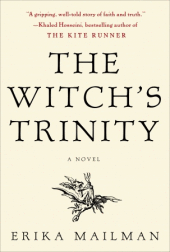
The Witch's Trinity by Erika Mailman
September, 2007 - 288 pages - $23.95
Erika Mailman: The column I write for the Montclarion is about the history of Oakland, California. I have complete freedom to come up with a topic, so often I find myself in the Oakland History Room (top floor of one of the library branches) combing through the photos or digging around the files until I find something that interests me. Being in the History Room actually led me to write my first historical novel Woman of Ill Fame, because one day my eye fell on a series of nonfiction books about early prostitution. Writing for a newspaper is quite different than writing a novel—I feel much more confined to truth-telling and getting facts straight. I think this was good practice for writing the Afterword for The Witch’s Trinity, in which I write about my ancestor Mary Bliss Parsons, who was accused of witchcraft in 1600s Massachusetts.


Kelly: The friar in your book who comes to save the town brings with him the
Erika: Sadly, the Malleus Maleficarum really does exist. It was written in 1486 by two German inquisitors blessed by the pope in their witchhunting duties. The book provides guidelines for how to locate witches, what to ask them, when to use torture, etc. Five hundred years later, you can still order a copy of this book! Its pseudo-legal language leaves your jaw hanging open at times in disbelief. Reading it is ultimately depressing. I highlighted my copy every time a quote left me enraged or sad… the whole thing is basically yellow now! My editor at Crown, Allison McCabe, had the idea of including a quote from this book at the beginning of each chapter of The Witch’s Trinity. I think that goes a long way to underscore the idea that although my novel is fiction, it could really be any woman’s story from that time. At my website www.erikamailman.com, I am working on having quotations from the Malleus Maleficarum constantly rotating on my home page. A typical one is this, which conveys both the assured tone and the shocking ludicrousness: “Although the devil can work without a witch, he yet very much prefers to work with one.”
Kelly: Güde , the elderly woman who fears that she will be pegged the town's
 alance. As for whether Güde is mad… When I was in college, I took a class in gothic fiction with professor Cedric Bryant. We spent two whole weeks discussing The Turn of the Screw (this during a special “semester” called Jan Plan, where you meet daily for five hours during January), and in particular James’ mastery of the unreliable narrator. Those of you who have read the Turn of the Screw remember that it is about two children reputedly haunted by evil servant ghosts. Yet, the story is told from the point of view of their current governess who seems unstable. James provides equal balanced evidence for whichever stance you adopt, that there are ghosts or that the narrator is insane. I was very, very inspired by this kind of plotting and tried my own hand at it. However, by the end of the novel I felt it would be an unkindness to the real women who were tortured and executed as witches to leave it hanging, so the main character comes to a pretty definitive conclusion about her own state of mind.
Kelly: Witch's Trinity isn't your first book. Can you tell us about
Erika: My first book is Woman of Ill Fame (The Witch’s Trinity is, however, considered my debut since the first was published by a wonderful small press in a very small edition). It follows the story of Nora Simms, a young prostitute in Gold Rush San Francisco who has aspirations of wealth and must avoid being targeted by a serial killer. In many ways, it’s the direct antithesis of The Witch’s Trinity—it’s a light romp, it’s funny. But the two novels share a few things, one being the idea of hunger. In The Witch’s Trinity, the main character is in danger because the village she lives in is famine-struck and hungry neighbors are seeking a scapegoat to blame. And in Woman of Ill Fame, the main character unashamedly plies her trade because she knows it is one of the few things she can do to put food in her mouth. Both novels also concern themselves with aspects of women’s history that is uncomfortable to think about: for The Witch’s Trinity, the four hundred years that women were persecuted as witches in Europe, and in Woman of Ill Fame, the fact that women were not permitted to seek employment other than in a small handful of trades. I still find it almost unbelievable that in the U.S. women were not allowed to vote until 1920… many of us know people who were alive back then! I spend quite a lot of time considering how lucky I am to have been born in this era-- and in this country where women fare better than in some others-- while at the same time being very drawn to the past.


Kelly: Your blog, The World of Mailman, has some really great information about
Erika: First of all, thank you!
I have always been interested in witchcraft. I was a true bookworm and early on devoured everything I could read on the subject, so those ideas have been moiling around in my head for several decades. As I mentioned before, the audiotapes of Teo Ruiz were the direct inspiration—hearing that desperately hungry people would accuse family members of witchcraft to have fewer mouths at the table made me determined to explore that terrible psychology. Another thread was learning about my own ancestor who was termed a witch and suffered through two trials. To my vast relief, she was acquitted and eventually died as an old woman. It felt strange to have witchcraft come so close to home, especially at a time when I was working on a novel about it! My hope with The Witch’s Trinity is that it motivates people to do some looking on their own, to learn more about this shameful time period—and then to reflect on the advances we’ve made towards understanding the world better… that random bad things happen and are not the fault of one’s neighbor.
Kelly: Readers have really loved Witch's Trinity and so I have have to ask
Erika: I’m working on a modern day novel about medical students, infertility, and parallel lives. I also outlined a novel taking place in revolutionary France and firmly believe I’ll get to it someday...


