
We all heard this week that French-born author and world traveler Jean-Marie Gustave Le Clézio was awarded the 2008 Nobel Prize for Literature. Le Clézio's father, a British native who worked for the British Army, moved his family to Nigeria when Jean-Marie was eight years old.
Le Clézio began his collegiate studies at Bristol University in 1958 but left the following year to attend Nice's Institut d’etudes Litteraires where he finished is undergraduate education. Le Clézio earned a master's degree with a thesis on Henri Michaux from the University of Aix-en-Provence in 1964 and wrote a doctoral thesis in 1983 on Mexico’s early history for the University of Perpignan where he became a specialist on Michoacán -- 31 constituent states of Mexico.
Jean-Marie has been married since 1975 to Jémia, who is Moroccan. Since the 1990s they have divided their residence between Albuquerque, New Mexico, Mauritius, and Nice. He has taught at numerous universities around the world. A frequent visitor to South Korea, he taught French language and literature at Ewha Womans University in Seoul for two semesters from 2007 to 2008.
One thing is to be sure -- Jean Marie Gustave Le Clézio certainly sounds like an interested individual.

After finding out the news of Le Clézio's winning, I know that myself and many other English-speaking bibliophiles wanted to know how many of his books are available in English, whether they are accessable to a casual (and yet entirely devoted) reader such as myself and finally where these titles could be found.
Have no fear! I have spent some time looking into the history of Le Clézio catalog of over thirty titles. The good news is that a number of his texts have indeed been translated into English, the bad news is that many of those that were published in the early and "experimental" phase of Le Clézio's career which began with Le procès-verbal (published in English as The Interrogation) in 1963.
Here is a rundown of available books written by the 2008 winner of the Nobel Prize for Literature along with links to where they can be purchased.
 Desert (1980)
Published in English by Gallimard Education, 1987
$16.45 at Amazon.com - Click to Purchase
Considered Le Clezio's break through novel despite the fact that it was released twenty years after the publication of his first book. When the Swiss Academy (which selects the winners of the Nobel Prize) announced their decision earlier this week they wrote that Desert "contains magnificent images of a lost culture in the North African desert, contrasted with a depiction of Europe seen through the eyes of unwanted immigrants." The Academy continued by announcing that “The main character, the Algerian guest worker Lalla, is a utopian antithesis to the ugliness and brutality of European society.” Desert, published in 1980, won an award from the French Academy.
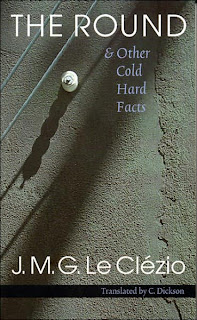 The Round & Other Cold Hard Facts
(La ronde et autres faits divers, 1982)
Published in English by University of Nebraska Press, 2002
$19.95 at Amazon.com - Click to Purchase
Le Clezio is known for writting moody and menacing short stories set in a fallen universe. Once a verdant paradise, Le Clezio's world has been brutalized with hideous concrete high-rise projects, heavy traffic, and pollution, and most adults hide in cell-like apartments bathed in television's narcotic blue glow. But the young are restless and reckless, and they pay dearly for their attempts at escape in "The Round," in which two teenage girls race their mopeds through their stodgy town at dangerously high speeds, and in "Ariadne," in which an urban adolescent, reluctant to be cooped up with her unhappy family, becomes prey to a motorcycle gang. Le Clezio is an intensely atmospheric, nearly hallucinatory writer, and in his riveting and eviscerating short stories, dreams turn inexorably into nightmares.
 The Prospector (Le chercheur d'or, 1985)
Published in English by Verba Mundi Books, 1993
$22.95 at Amazon.com - Click to Purchase
Haunting and lyrical, this Bildungsroman of the narrator's search for the lost treasure of the Corsair is near-mythic but has realistic details that bolster its plausibility. Set in early 20th-century Mauritius, the story follows the life of a young man who, after the death of his father, tries to restore his family's fortunes by tracking down some buried gold (hence the title); he is assisted by a young island woman, reminiscent of Rima in William H. Hudson's Green Mansions , who helps him recognize other things of value. The simple, exotic life of the islanders is portrayed appealingly, but realistic details of their exploitation by European colonists and the miseries of war are not left out. Le Clezio is an acclaimed winner of the French Prix Renaudot, and this novel, a best seller in France.
 The Mexican Dream (Le Rêve mexicain ou la pensée interrompue, 1988)
Published in English by University of Chicago Press, 1993
$25.00 at Amazon.com - Click to Purchase
This examination of ancient Mesoamerican religion and myth is based on 16th-century chroniclers' accounts of Aztec and Maya myths and covers familiar ground. French novelist and pre-Columbian scholar Le Clezio's interest in these ancient civilizations is purely literary, in accord with the romantic French attachment to the lost world of ancient America that fascinated Guillaume Apollinaire and the Surrealists Antonin Artaud and Georges Bataille. Like them, Le Clezio is particularly enchanted with the "sacred horror" and "terrifying beauty" of pre-Columbian myth and magic and their ritual identification with death. What is freshest here is Le Clezio's linkage of North American and Mesoamerican Indian religious beliefs. He concludes his uneven study with wistful speculation about what might have been if the Spanish Conquest had not interrupted the religious and philosophical development of these civilizations: their rituals and myths might have given shape to a true philosophy, on a par with Taoism or Buddhism.
 Onitsha (1991)
Published by Bison Books, 1997
$15.00 at Amazon.com - Click to Purchase
In 1948, a 12-year-old boy named Fintan is sailing to Africa with his Italian mother to live with the British father he doesn't remember. At times, this French novel paints too precious a picture of the young Fintan and his mother, who occasionally writes down poetic bits like "In my hands I hold the prey of silence." The ship's voyage can drag, too, with too many hints about the characters' previous lives (upon learning that Fintan has contracted scabies, his mother cries out "A barnyard disease!"). But once the pair arrive in Onitsha, in Nigeria, Fintan's views of the colonial situation and the different ways that Europeans adapt to their surroundings prove fresh and valuable, though suffused with the unworldly morality of the innocent. He befriends Bony, the son of a fisherman, who teaches him a new way of seeing nature. The relationship between Fintan's parents crackles with difficulty as they attempt to readjust to each another after their long separation and as his mother strains against local customs. At a dinner party hosted by a man who has commissioned prisoners to dig a swimming pool, Fintan's mother insists that the chained prisoners be allowed something to eat and drink. Her request is met, but she is then ostracized by polite society. Eventually, Fintan's father loses his job with the United Africa Company and moves the family first to London, then to the south of France.
 Wandering Star (Étoile errante, 1992)
Published in English by Curbstone Books, 2004
$15.00 at Amazon.com - Click to Purchase
This novel is a bewitching storyteller with a penchant for tales of survival that are at once acutely realistic and mythically romantic. In his latest hauntingly lyrical yet clear-eyed and worldly novel, he tells the story of two young women uprooted by the Holocaust and the establishment of the state of Israel. Esther and her parents are hiding from the Germans in a mountain village where the children run wild and grow strong while the adults risk their lives in the Resistance movement. Esther survives and, after much suffering, embarks on an arduous journey to Jerusalem. But as she and her fellow exhausted travelers finally near their promised land, they pass a stream of equally despairing, newly displaced refugees, among them Nejma, a Palestinian girl. Nejma then chronicles the misery of a gravely ill-provisioned camp and her heroic escape. Exquisitely attuned to nature's quest for balance and humanity's penchant for excess and paradox, Le Clezio writes with high compassion and deep wonder of the boundless strength of the spirit.