
 Kelly Hewitt
: Part of what makes your debut novel
Mudbound such a great literary work is the fact that you use the voices of many of your characters via narratives which tell the story from their point of view. I have really come to love the multiple viewpoints this affords both the author and the reader. You used the narratives of Laura, Henry, Jamie, Ronsel, and his parents, Florence and Hap, but were there any other characters that you wrote narratives for but didn't use?
Hillary Jordan: Yes, actually Pappy used to narrate his own funeral (the two scenes at the beginning and end of the book). And people — namely, my editor and Barbara Kingsolver, who read several drafts of Mudbound and gave me invaluable criticism — just hated hearing from him first, or in fact, at all. Eventually I was persuaded to silence him. The more I thought about those two passages, the more fitting it seemed that Jamie should narrate them.
Kelly: Which of those character point of views came to you first? Or was there even a "first"?
Hillary: Yes, Laura was the first, and only, voice for some while.
Mudbound started as a short writing exercise in grad school. The assignment was to write 3 pages in the voice of a family member, so I decided to write about my grandparents’ farm — a sort of mythic place I’d grown up hearing about, which actually was called Mudbound — from my grandmother’s point of view. My teacher liked what I wrote and encouraged me to continue, and I tried to write a short story. Nana became Laura, a fictional character who is much more fiery and rebellious than my grandmother ever was, and the story got longer and longer. At 50 pages I realized I was writing a novel, and that’s when I decided to introduce the other voices. Jamie came next, then Henry, then Florence, then Hap. Ronsel wasn’t even a character until I had about 150 pages! And of course, when he entered the story, he changed its course dramatically.
Kelly: I read in another interview that the idea for the book was inspired by stories from your mother, who spent a year on a farm with no running water or electricity, and that many of these stories were funny. Where was the family farm?
Hillary: Outside of Lake Village, Arkansas, just across the Mississippi River from Greenville. But I decided to set my story in the Mississippi Delta instead because it really is, as James Cobb says in the title of his excellent book about the Delta, “the most Southern place on earth.”
Kelly: In researching the novel did you spend time at any farms to get a better idea for life there?
 Hillary
: Nope. But I spent a couple of eons in libraries, reading about farming. I did go to Mississippi for a week early on to get a feel for the place and its people. That was the first time I’d ever been there.
Kelly: In another interview you said, "I know more than should be legally allowable about mules, boll weevils, fertilizer, and the like!" What was the most interesting or practical piece of WWII era farming that you learned while researching?
Hillary: That owning your own mule meant the difference between share tenancy, in which you got to keep half your crop, and sharecropping, in which you got to keep only a quarter. A quarter of a cotton crop wasn’t nearly enough for a family to live on, so people went further and further into debt with their landlords. The perniciousness of the sharecropping system, and the vulnerability (to misfortune, to illness, to bad weather conditions) of the people who labored under it, were just astounding to me. Being a sharecropper was not far removed from being a slave.
Kelly: Everyone who has read this book has loved it and many credit it to the way in which you detail life on the farm and the social/political struggles of the time period. What books would you recommend to those who have read Mudbound and want to know even more about the period?
 Hillary
:
All God’s Dangers: the Life of Nate Shaw, by Theodore Rosengarten. This is a true first-person account of a black Alabama cotton farmer who started out as a sharecropper and ended up owning his own land, with many adventures along the way. Nate was an indelible character, smart (though illiterate) and funny and perceptive about people. He was eighty years old when he told his life story to Theodore Rosengarten, a journalist from New York. And what a fascinating life it was. Some of the more colorful phrases in the book come from Nate Shaw.
James Cobb’s
The Most Southern Place on Earth.Pete Daniel’s excellent books
Breaking the Land and Deep’N As It Come: The 1927 Mississippi River Flood and Standing at the Crossroads: Southern Life in the Twentieth Century
A PBS series of documentaries about black history called "The American Experience".
Clifton Talbert’s
Once Upon a Time When We Were Colored.And of course, the works of William Faulkner, Flannery O’Connor, Eudora Welty, and Richard Wright, among others.
Kelly: Author Barbara Kingsolver has said, "I love that you understand everybody, even though everyone isn't right, and in the long run some people are very wrong, but you begin by feeling their own perspective, and you have some sympathy for every character." There most certainly is a level of sympathy even for the most despicable of characters in the book. Was that sympathy and relation towards each of the characters something that you consciously worked towards?
Hillary: I think you have to have sympathy for a character in order to really get inside his or her head. I’ve gotten some criticism about Pappy — that he is a two-dimensional villain — but even he has a soft point, which is his love for Jamie.
Kelly: Having read some of the reviews written by your readers it is clear that the mean and sour character Pappy, Henry's father who comes to live with the family on the farm, has really struck a chord. Why do you think that is?
Hillary: Yes, people really do seem to hate him! Which is as it should be — he’s pretty detestable. He embodies not just the ugliness of the Jim Crow era, but the absolute worst possibilities in ourselves.
Kelly: It’s time for a theoretical question. Let’s set aside time, place, and fiction and say that you're having Pappy over for dinner. What do you serve? And let me say that this

is a question so ridiculous that we may cut it from the end interview!
Hillary: Fried chicken and biscuits, of course, with green beans cooked in onion and bacon fat, and a little arsenic tossed in for good measure.
Kelly: Publisher's Weekly has compared your debut novel to Faulkner's
As I Lay Dying with its narrative, burial scene, and flood. First of all, how does that feel to be compared like that?
Hillary: Astonishing and incredibly flattering, but on a different level, also somewhat puzzling. The comparison is probably inevitable given the Mississippi setting and the multiple voices, but I don’t think I write anything like Faulkner.
Kelly: Second of all, your novel and characters must get compared to all sorts of things. I read a review in which the book was compared to Othello and one of your characters (which I won't give away) likened to Iago. What is the strangest comparison you've heard yet?
Hillary: I think that’s probably it. I saw that review too and went, huh?
Kelly: Have you headed out on a book tour yet? How has that experience been?
Hillary: I spent March and most of April on book tour. As I say in my blog on my website, the experience was exhilarating, exhausting, fun, tedious, gratifying, occasionally humiliating, and totally consuming.
Kelly: Time for the inevitable question. What can we expect next? Have you begun working on another novel?
Hillary: Yes, and it’s absolutely nothing like
Mudbound! After seven years of working on it, I was extremely ready to leave the Deep South, the past, and the first person. My second novel,
Red, is set in a dystopian America roughly thirty years in the future. It begins in Dallas, Texas and ends — well, who knows?

 I often chat with authors as their books are about to be released or have just hit stores. It is not often that I am able to check in with an author to see what life after the arrival of a best-selling book hits the charts is like. Book tours, interviews and the of course there's always the writing of the next book.
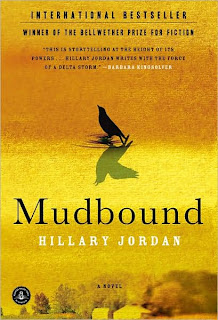 We begin with Hillary Jordan author of Mudbound her first novel and winner of the 2006 Bellwether Prize. Mudbound takes place in Mississippi Delta, 1946 and focuses on Laura McCallan, a college-educated Memphis schoolteacher who struggles to adapt to her new life on a farm she rightly names Mudbound. Living without modern comforts is a challenge for Laura added to caring for her daughters and striving to live up to her loving husbands expectations. Mudbound, told from the point of view of a number of characters, is a great novel and has been doing very well on Amazon, landing on several bestselling lists and continuing to do so in paperback.
 The fifteen months since Mudbound was published have been a whirlwind. Thanks to Algonquin, which has championed the book in a way that most first novelists never get to experience, I’ve spent a tremendous amount of time on book tour, doing readings, signings and festivals all over the country. It has been exhilarating, exhausting, fascinating, gratifying and occasionally humiliating (like the Memphis talk show I was on where I was clearly second fiddle to a guy eating a 7-lb. hamburger). I’ve gotten to meet so many wonderful book-loving people: fans, booksellers, and other authors. In between, I’ve been going to artists colonies — in Switzerland, Saratoga Springs, the Santa Cruz mountains, and this autumn, Scotland — to work on my second novel. It’s called Red, and it’s set thirty years in the future in a right-wing dystopia (not to be confused with the last eight years). I hope to finish it by the end of the year.


